Gyoza came to Japan from Chinese jiaozi, but the Japanese version has its own logic. The wrappers are thinner. Garlic is more present. The filling is finer, almost creamy, and the cooking method is less about boiling than about contrast. In Japan, gyoza is a specialist dish. Ramen shops serve it because it works beside broth and beer, not because it is an afterthought.
The best homemade batch does not taste rustic. It tastes precise. Every gram matters, especially the salt, the cabbage moisture, and the ratio between pork fat and aromatics. That is why most disappointing gyoza fail in predictable ways: watery filling, wrappers that split, bottoms that burn before the steam phase, or bland centres hidden behind soy sauce.
What makes Japanese gyoza different
Japanese gyoza are usually smaller than northern Chinese dumplings and flatter once pleated. They are designed for yaki-gyoza, the pan-fried style that starts in oil, continues under steam, and finishes dry again. That is the whole point: crunch, then softness, then a savoury pork-and-cabbage filling that gives way almost instantly.
If you want restaurant texture, do not overfill them. A compact crescent shape cooks evenly and develops a better crust. A bloated dumpling may look generous, but it steams badly and collapses the moment you try to pick it up.
The filling, in exact grams
This recipe makes about 26 to 30 gyoza, enough for 4 people as a starter or 2 very committed adults as dinner with rice and cucumber salad.
- 250 g ground pork, ideally around 20% fat
- 180 g green cabbage, finely shredded
- 35 g garlic chives or spring onion, finely sliced
- 12 g fresh ginger, grated
- 10 g garlic, grated
- 12 g soy sauce
- 8 g sake
- 6 g toasted sesame oil
- 5 g fine salt
- 2 g sugar
- 1 g white pepper
- 30 g water, added gradually
- 30 g potato starch or cornflour
- 26 to 30 round gyoza wrappers
The potato starch is not there to bulk up the mix. It helps bind the meat juices once heat hits the filling, which keeps the inside tender instead of wet and grainy. If you skip it, the texture is looser and less polished.
Step 1, control the cabbage water
This is the part most people rush, and it is exactly where texture gets destroyed. Toss the shredded cabbage with the salt and leave it for 10 minutes. Then squeeze it hard, really hard, until a surprising amount of liquid comes out. You want the cabbage seasoned, softened, and lighter, not dripping. If it keeps its water, the filling leaks during steaming and the wrappers go slack.
Step 2, mix like a cook, not like a baker
Put the pork, ginger, garlic, soy sauce, sake, sesame oil, sugar, white pepper and starch in a bowl first. Mix vigorously with chopsticks or your hand in one direction until the meat becomes sticky and slightly pale. Then add the water in three additions. Only after that do you fold in the drained cabbage and chives. This order matters. It builds a fine, cohesive emulsion before the vegetables interrupt it.
The final filling should feel tacky and compact, almost like a soft sausage farce. If it is crumbly, it has not been worked enough. If it is soupy, the cabbage was too wet.
Step 3, fold fast and keep the wrappers covered
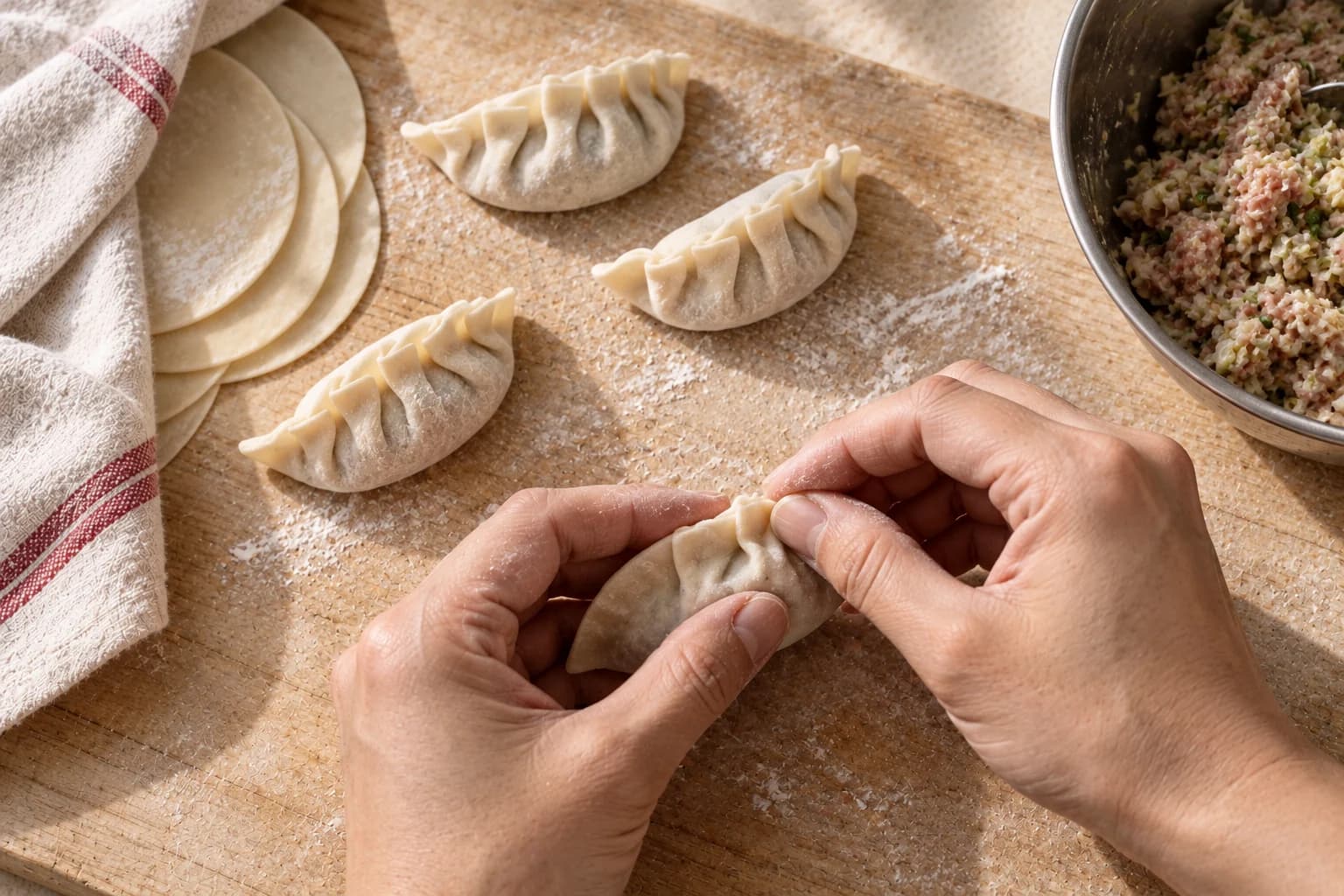
Place around 16 g of filling in the centre of each wrapper. Wet the upper half-edge with water. Fold into a half moon, then make 4 or 5 pleats on one side only, pressing firmly to seal against the flat back edge. That gives the classic Japanese crescent. Do not aim for decorative perfection. Aim for an airtight seal and a stable base so the dumpling can stand in the pan.
Keep the unused wrappers under a lightly damp cloth. They dry out faster than people think, and once the edge loses flexibility it cracks instead of sealing.
Step 4, the pan-fry and steam method
Heat a non-stick or well-seasoned frying pan over medium heat. Add 10 g neutral oil. Arrange the gyoza flat side down in a curved row or tight spiral, leaving almost no gap. Fry for about 2 minutes, just until the bases start turning light gold.
Now add 70 g water mixed with 5 g starch if you want that lacy restaurant skirt, or plain water if you do not. It should come about one-third of the way up the dumplings. Cover immediately. Steam for 4 minutes. Uncover, let the liquid evaporate, then continue cooking 1 to 2 minutes more until the underside is deeply crisp. The sound tells you when it is right. You stop hearing bubbling water and start hearing dry frying.
Dipping sauce, keep it sharp
The standard ratio is simple: 2 parts rice vinegar, 2 parts soy sauce, and a few drops of chilli oil if you like heat. Japanese gyoza sauce is not meant to hide the dumpling. It should brighten pork fat and echo the garlic, nothing more. Heavy sweet sauces ruin the balance.
Four chef techniques that change everything
- Use colder filling than you think. Ten minutes in the fridge before folding makes wrapping cleaner and reduces leakage.
- Do not flour the tray. Use starch lightly or parchment. Flour burns in the pan and leaves bitter spots.
- Cook in batches you can control. Overcrowding is fine inside the pan, not on the prep station.
- Flip only when serving as a group. In many ramen shops, the whole batch is turned onto a plate in one motion so the crisp side faces up intact.
Common mistakes
Too much filling, too much heat, and not enough patience. Those are the classics. Another frequent mistake is using very lean pork. It sounds virtuous and tastes dry. Gyoza need some fat. The cabbage and vinegar cut through it anyway.
The other trap is thinking the wrapper should brown all over. No. A good gyoza has one crisp face and one steamed face. Uniform colour usually means uniform mediocrity.
Can you freeze them?
Yes, and you should. Freeze the uncooked gyoza flat on a tray first, then bag them once solid. Cook from frozen with the same method, adding about 1 extra minute during the covered steam phase. They will never be worse than shop-bought frozen gyoza, and usually they are a lot better.
Why this matters to us at TontonKatsu
Gyoza are not our headline dish the way tonkatsu is, but they belong to the same family of Japanese precision comfort food. They look casual, but casual food is where technique gets exposed. If the pleat is weak, if the bottom is greasy, if the filling tastes anonymous, there is nowhere to hide.
That is exactly why we love them. A plate of good gyoza tells you a lot about a kitchen. It tells you whether someone cares about texture, moisture, seasoning, and timing. In other words, the same things that separate average fried food from the real thing.
At TontonKatsu
We care about the details because that is where Japanese food lives.
If this kind of obsessive texture talk sounds like your idea of a good time, you are very much our type of customer.