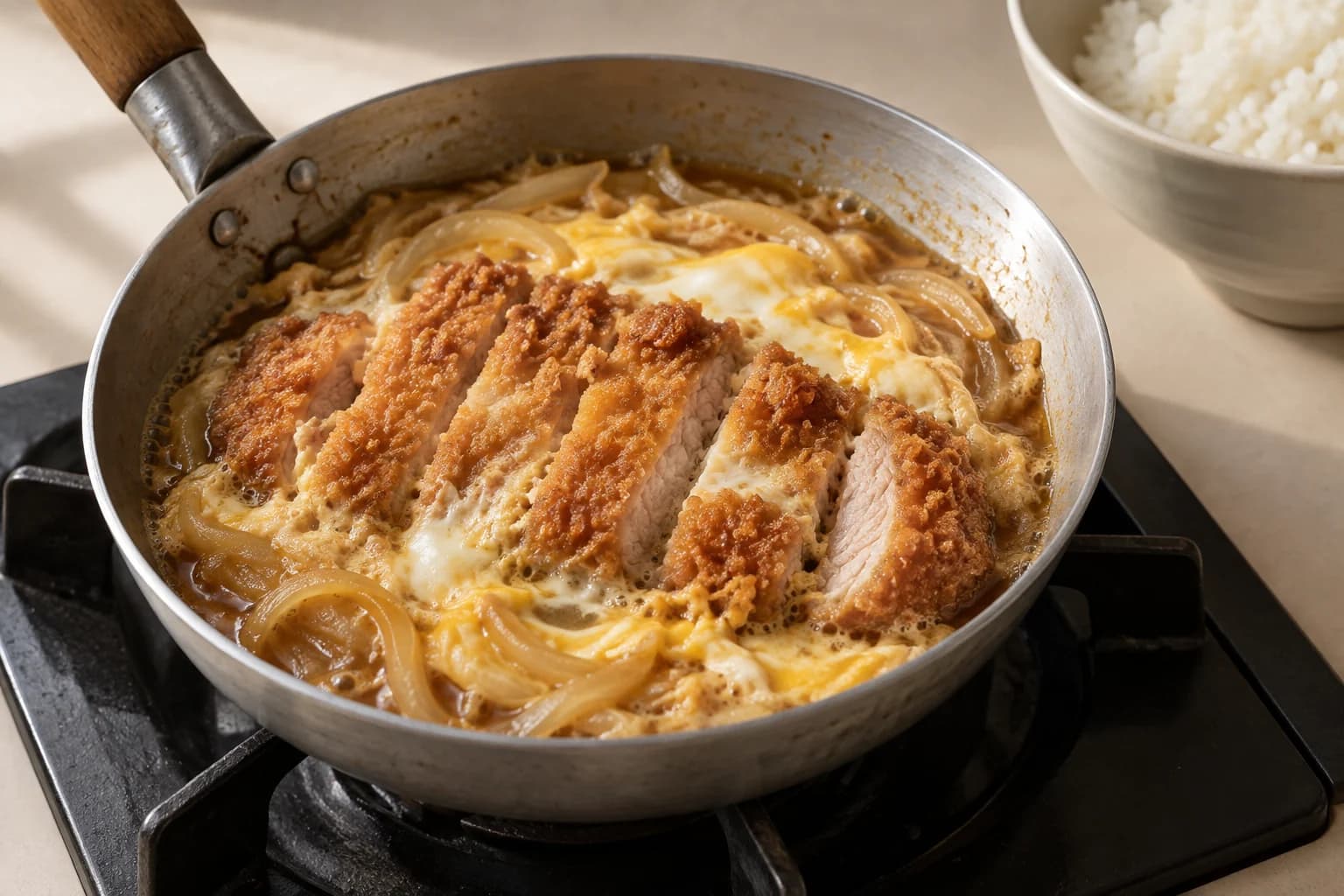
Picture the scene: a thin stream of beaten egg spiralling into a hot pan. It hits the sweet-savoury dashi, instantly thickens, and starts to wrap itself around slices of golden tonkatsu still crackling from the fryer. That silky, trembling veil of egg — half-set, never fully solid — is the heart of katsudon. Japan's ultimate comfort food, cooked in under ten minutes, beloved by students, office workers, and street-food obsessives alike.
What is katsudon?
Katsudon (カツ丼) is a donburi — a Japanese rice bowl dish — in which tonkatsu (breaded pork cutlet) is simmered briefly in a seasoned dashi broth with thinly sliced onions and poured-over beaten eggs, then served over a bowl of steaming white rice. The name is a portmanteau: katsu (カツ) from tonkatsu, and don (丼) from donburi.
It belongs to the same family as oyakodon (chicken and egg) and gyudon (beef), but katsudon has a unique texture game: the crispy panko crust of the tonkatsu absorbs the broth just enough to become tender and juicy at the edges, while the centre holds its satisfying crunch. That contrast — soft rice, saucy egg, and still-crispy pork — is what makes the dish so compulsive.
A brief history: from Meiji-era innovation to exam-day ritual
Katsudon emerged naturally in the early 20th century as an ingenious way to use leftover tonkatsu. Its exact birthplace is disputed — both Waseda University's Daikanyama neighbourhood and the city of Fukui claim the invention — but the dish was already well established across Japan by the 1920s. Cheap, fast, protein-rich, and deeply satisfying, it became a staple of the shokudo (casual diner) and university canteen.
Beyond its culinary appeal, katsudon carries a powerful cultural meaning. In Japanese, katsu (カツ) is a homophone of katsu (勝つ), meaning "to win" or "to triumph". This linguistic coincidence turned katsudon into a lucky charm food: generations of Japanese students have eaten it the evening before university entrance exams (juken) to ensure victory. The tradition persists today, and convenience stores like 7-Eleven run katsudon promotions every exam season.
The authentic recipe — exact proportions for one serving
Ingredients (1 serving)
- • 1 tonkatsu (hire or rosu, 120–150 g) — freshly fried or reheated in oven at 180°C for 8 min
- • 80 g onion (½ medium onion), thinly sliced
- • 2 whole eggs
- • 200 ml dashi (kombu + bonito — or good instant dashi)
- • 1 tbsp soy sauce (Japanese — Kikkoman or equivalent)
- • 1 tbsp mirin
- • 1 tsp sugar
- • 200 g cooked white rice (Japanese variety, short-grain)
Step-by-step instructions
-
1
Prepare the broth
Combine dashi, soy sauce, mirin, and sugar in a small oyakodon pan (18 cm) or sauté pan. Stir to dissolve the sugar. This is your warishita — the seasoning broth. Taste it now: it should be sweet, savoury, and deeply umami. Adjust if needed.
-
2
Cook the onions
Add the sliced onion to the cold broth, then bring to a gentle simmer over medium heat. Cook 3–4 minutes, stirring occasionally, until the onion is translucent and beginning to soften. It should still have a slight bite — it will continue cooking with the egg.
-
3
Slice and add the tonkatsu
Cut the tonkatsu crosswise into 2 cm slices — do not separate the slices, keep them in their original shape. Lay them side by side over the onions. Simmer for 1 minute so the panko absorbs some of the broth on the underside.
-
4
The egg — the critical step
Beat the 2 eggs lightly — 10–12 strokes only. You want visible streaks of white and yolk, not a uniform mixture. Increase heat to medium-high. Pour the egg in a circular motion over the tonkatsu and onion. Cover immediately with a lid.
-
5
45–60 seconds, then off the heat
Cook covered for 45–60 seconds. The egg should be half-set at the edges, still trembling in the centre. This is the Japanese toro toro (とろとろ) texture — creamy, silky, barely cooked. Remove from heat: residual heat will finish the job as you plate.
-
6
Slide onto the rice
Fill a deep bowl with hot rice, pressing gently so it mounds slightly. Hold the pan close to the bowl and slide the entire katsudon topping — onions, tonkatsu, and egg — over the rice in one confident motion. Serve immediately.
5 mistakes that ruin katsudon
1. Fully cooking the egg
The biggest katsudon sin. Overcooked egg turns rubbery and loses its silky coating function. Pull the pan off the heat when the centre is still visibly liquid — the residual heat does the rest.
2. Over-beating the eggs
A fully homogeneous egg mixture sets uniformly and quickly. A lightly beaten egg with visible streaks sets in waves — some parts creamy, some still liquid — giving that characteristic Japanese texture.
3. Skimping on dashi quality
The broth is everything here — it's the soul of the dish. Use real dashi (kombu + bonito) or at minimum a quality instant dashi (Ajinomoto Hondashi is fine). Chicken stock is not a substitute — the delicate umami profile is completely different.
4. Using cold or soggy tonkatsu
Cold tonkatsu won't release its juices into the broth, and refrigerated panko loses its structure completely when simmered. Reheat in an oven (180°C, 8 min) before using, never in a microwave.
5. Wrong pan size
Too large a pan and the broth spreads too thin, evaporating before the egg sets. Too small and the tonkatsu won't fit flat. An 18 cm pan is ideal for one serving — the classic Japanese oyakodon-nabe size.
Regional variations: beyond the classic
While the Tokyo version described above is the standard, Japan has a rich ecosystem of katsudon variants. Sauce katsudon from Fukui prefecture (one of the claimed birthplaces of the dish) completely dispenses with the egg: a thin tonkatsu is dipped in a hot worcestershire-based sauce and laid directly over rice. Purists in Fukui consider the Tokyo egg version a later innovation. Miso katsudon from Nagoya swaps the soy-mirin broth for a rich hatcho miso sauce — deeper, earthier, intensely savoury.
There is also oyako katsudon (親子カツ丼), which adds chicken alongside the pork — a playful twist on oyakodon (parent-and-child bowl, traditionally chicken and egg). And in recent years, cheese katsudon has become popular: a slice of melting cheese is added between the tonkatsu and the egg, creating a richer, more indulgent version that resonates with younger Japanese diners.
Where to eat katsudon in Paris
Authentic katsudon — with proper dashi broth, quality tonkatsu, and that essential toro toro egg — remains rare in Paris. Two addresses stand out as genuinely worth the trip.
Tonkatsu Tombo
15th arrondissement — Montparnasse
14 Rue de l'Arrivée, 75015. One of Paris's longest-established tonkatsu specialists. Their katsudon uses in-house panko and a well-balanced dashi. The egg is consistently cooked to the right toro toro texture — a rare achievement outside Japan. Arrive early; it fills up at lunch.
Katsu Katsu
2nd arrondissement — Opéra
25 rue Saint-Augustin, 75002. Opened January 2026. A newer address with a more modern approach to katsu cuisine, including a well-executed katsudon on the lunch menu. Quality tonkatsu, clean flavours, and a brighter dining room than most Japanese canteen-style spots.
West Paris — Croissy-sur-Seine, Chatou, Le Vésinet, Saint-Germain-en-Laye — has no dedicated katsu restaurant within a 12-kilometre radius. If you're based in the western suburbs, your options are currently limited to the above (both requiring a 30+ minute journey) or making it at home with the recipe above. That is precisely the gap TontonKatsu is being built to fill.
Katsudon at TontonKatsu
At TontonKatsu, katsudon will be on the menu from day one. Our version will follow the Tokyo tradition: house-made panko, premium pork (hire or rosu depending on the day's selection), real kombu-and-bonito dashi, and eggs cooked to that precise toro toro point. Not rushed, not over-simplified. The dish that a generation of Japanese students ate before their most important exams deserves that level of attention.
Fancy trying real tonkatsu in West Paris?