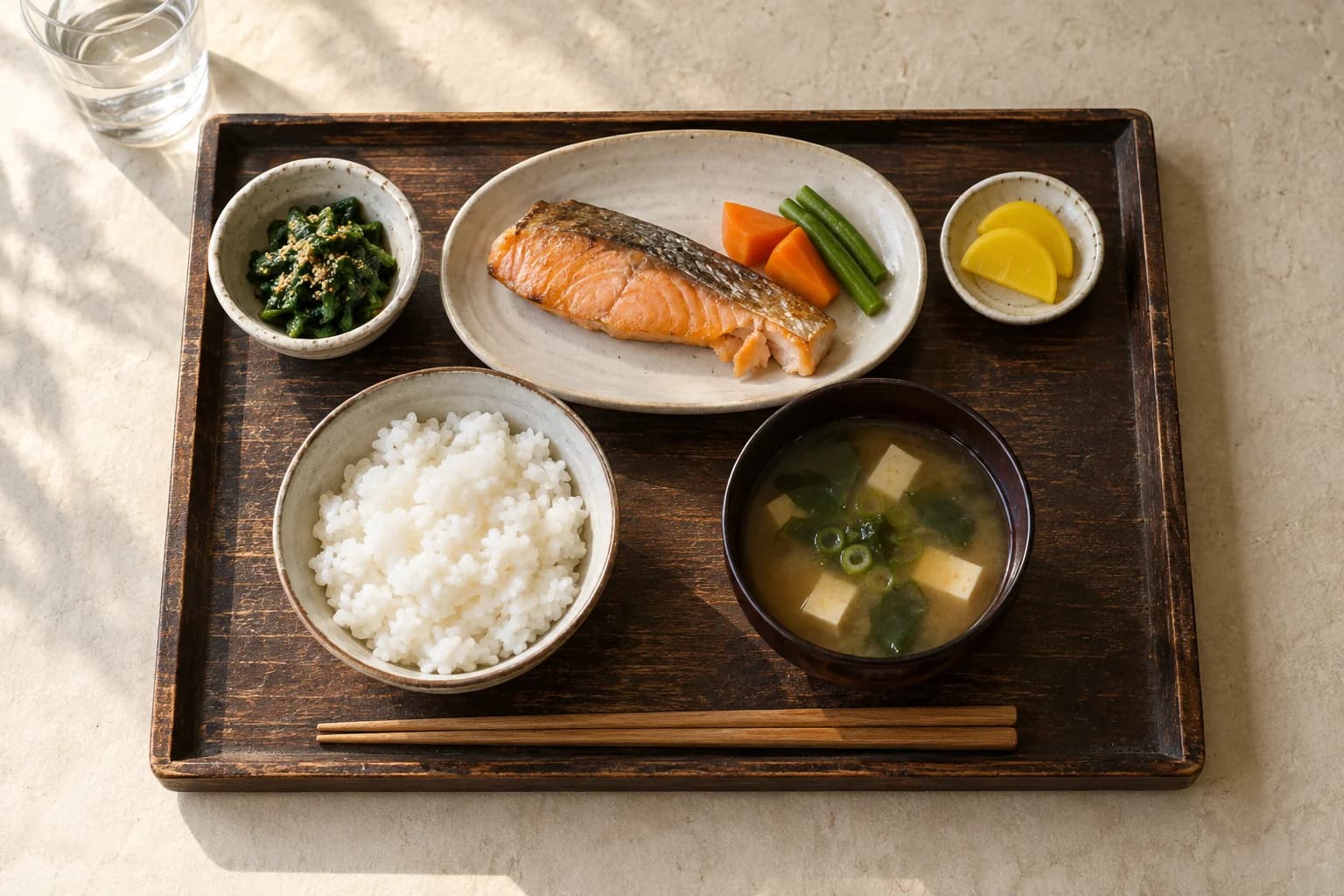
In Japan, teishoku means set meal, but that translation misses the point. The word sounds administrative in English, like something printed on a plastic menu under fluorescent lights. In real life it feels warmer than that. It is the daily architecture of eating well without drama. One tray, one rhythm, one balanced meal, usually priced around 900 to 1,400 yen in a neighborhood shop, which is exactly why it survived every wave of convenience culture.
Walk into a teishoku-ya at 12:40 in Tokyo and you see the same scene repeating with tiny variations. Office workers loosen their ties, students lean over their bowls, an older couple splits grilled mackerel and extra natto, nobody performs for Instagram, nobody needs a tasting menu speech. The food is already doing the talking. Salt, steam, crunch, acid, starch, broth. It is practical, but it never feels careless.
Not a dish, a format
A teishoku is not one recipe. It is a system. The center changes, grilled salmon one day, karaage the next, tonkatsu when you want the heavy hit of fat and panko, but the frame stays stable. Rice gives you volume and calm. Soup brings heat and moisture. Pickles cut through the richer bites. A small side, maybe spinach with sesame or cold tofu with grated ginger, keeps the tray from becoming monochrome. Every element earns its square centimeters.
That matters because the Japanese table has long treated balance as something physical, not abstract. You do not explain balance with macros first, you feel it. The sharpness of takuan after a fried cutlet. The softness of rice after salty miso. The way shredded cabbage cools the mouth at exactly the moment the tonkatsu sauce starts feeling too thick. Good teishoku is a sequence problem solved on a tray.
The standard build, bowl by bowl
Start with rice. A typical serving is 180 to 200 g cooked, usually Japanese short-grain rice, glossy, lightly sticky, hot enough to fog your glasses if you lean in too fast. In a Western meal that might look like a side. In teishoku it is the anchor. You eat it in small alternating bites, never as a separate phase at the end. Rice is what keeps the tray coherent.
Then miso soup, around 180 to 220 ml, often built on dashi made from kombu and katsuobushi. You smell the bonito before you fully taste it, a soft marine note that sits behind the salt and fermented sweetness of the miso. A few cubes of tofu, some wakame, sliced negi if the shop is generous. Nothing fancy, but when the bowl is missing the whole meal feels incomplete, like a sentence without punctuation.
Then the pickles, which look minor until you remove them. Takuan, cucumber tsukemono, maybe a sour umeboshi if the place leans traditional. They arrive in tiny quantity because they are not garnish, they are calibration tools. One slice of daikon pickled in rice bran can reset your palate harder than a glass of water.
Finally the main. This is where the personality of the shop shows up. Saba shioyaki if the room smells like grilled fish and charcoal. Ginger pork if lunch needs to move fast. Tonkatsu if the kitchen wants to hear that dry crack when the knife crosses the crust. In a tonkatsu teishoku, the cutlet is not alone. It comes with 60 to 100 g of shredded cabbage, cold and sharp, often refillable, because fried pork without cabbage is just bad planning.
Why the tray layout matters
The arrangement is not random. Rice tends to sit front left, soup front right, main plate at the back, side dishes tucked into the remaining corners. It sounds obsessive until you use it for a week and realize your hands stop searching. The body learns the map. Bowl, chopsticks, sip, bite, crunch, back to rice. Teishoku reduces friction. That is one reason it works so well for daily life, especially lunch, when people have 35 minutes, not 3 hours.
There is also an aesthetic point here. Japanese food often treats empty space as part of the flavor. A tray with too many ramekins feels noisy. A tray with the right gaps feels calm. The same meal can taste heavier if it looks crowded. That is not mystical, it is sensory design. Your eye reaches the food before your mouth does.
The home version, with actual quantities
A teishoku sounds elaborate until you build one yourself and realize the intelligence is in the proportions. For a simple tonkatsu teishoku at home for two people, cook 300 g raw Japanese rice which gives roughly 700 g cooked, enough for two bowls with a little margin. Make 500 ml dashi, whisk in 35 g white miso off the heat, add 80 g silken tofu and 5 g dried wakame rehydrated. Shred 160 g cabbage as thin as you can without losing your mind.
For the main, use 2 pork loin cutlets of 180 to 200 g each, around 2 cm thick. Salt lightly, flour, dip in 1 beaten egg, coat with 90 to 100 g panko, fry at 170 to 175°C until the crust is deep gold and the center hits the doneness you want. Rest the meat for a minute, slice into strips, plate beside the cabbage, add 30 g pickles per person, and suddenly dinner looks less like a project and more like a very competent idea.
That is the trick. Teishoku does not rely on luxury products or chef theatrics. It relies on the contrast between hot and cold, soft and crisp, bland and salty, deep-fried and fermented. It is engineering by repetition, refined until each component makes the others taste more like themselves.
Why it still matters now
Modern food culture loves extremes. Cheat meals, tasting menus, protein hacks, grab-and-go bars, giant burgers stacked for photos. Teishoku quietly ignores all that. It says lunch can be satisfying without becoming a spectacle. It says everyday food deserves structure. It says a complete meal should leave you clearer at 14:00, not half-dead at your desk.
That is probably why it keeps showing up across Japan, from old school diners near train stations to chain restaurants that serve a decent grilled fish set for less than a Paris salad. The format is resilient because it respects ordinary life. It knows most meals are not celebrations. They are maintenance, comfort, rhythm, and sometimes one good fried cutlet on a rainy Wednesday.
What we love about it at TontonKatsu
At TontonKatsu, the teishoku idea matters because tonkatsu alone tells only half the story. The pork is the headline, sure, but the meal becomes truly Japanese when the supporting cast is treated seriously. Warm rice, real miso soup, crisp cabbage, pickles with actual bite. Remove those and you still have a cutlet. Keep them and you have a meal with logic.
That is what makes teishoku beautiful. It turns restraint into generosity. Nothing on the tray is huge, yet nothing feels missing. You finish, set the chopsticks down, and the body understands before the brain does. Yes, that was enough. Exactly enough.
FAQ — Teishoku
What is a teishoku exactly?
A teishoku is a complete set meal served on a tray, usually with rice, soup, a main dish, and small sides. It is designed for balance, satiety, and daily eating rather than spectacle.
What goes into a classic teishoku?
Usually 180 to 200 g of cooked rice, a bowl of miso soup, a main dish like tonkatsu or grilled fish, pickles, and sometimes a small vegetable or tofu side.
What is the difference between a teishoku and a bento?
A teishoku is served and eaten on site, hot, with soup on the side. A bento is packed for transport inside a box, so the logic is more practical and less immediate.
Read next
What is tonkatsu? The complete guide to Japan's iconic dishPanko: why Japanese breadcrumbs change everythingHire katsu vs rosu katsu: which cut should you choose?