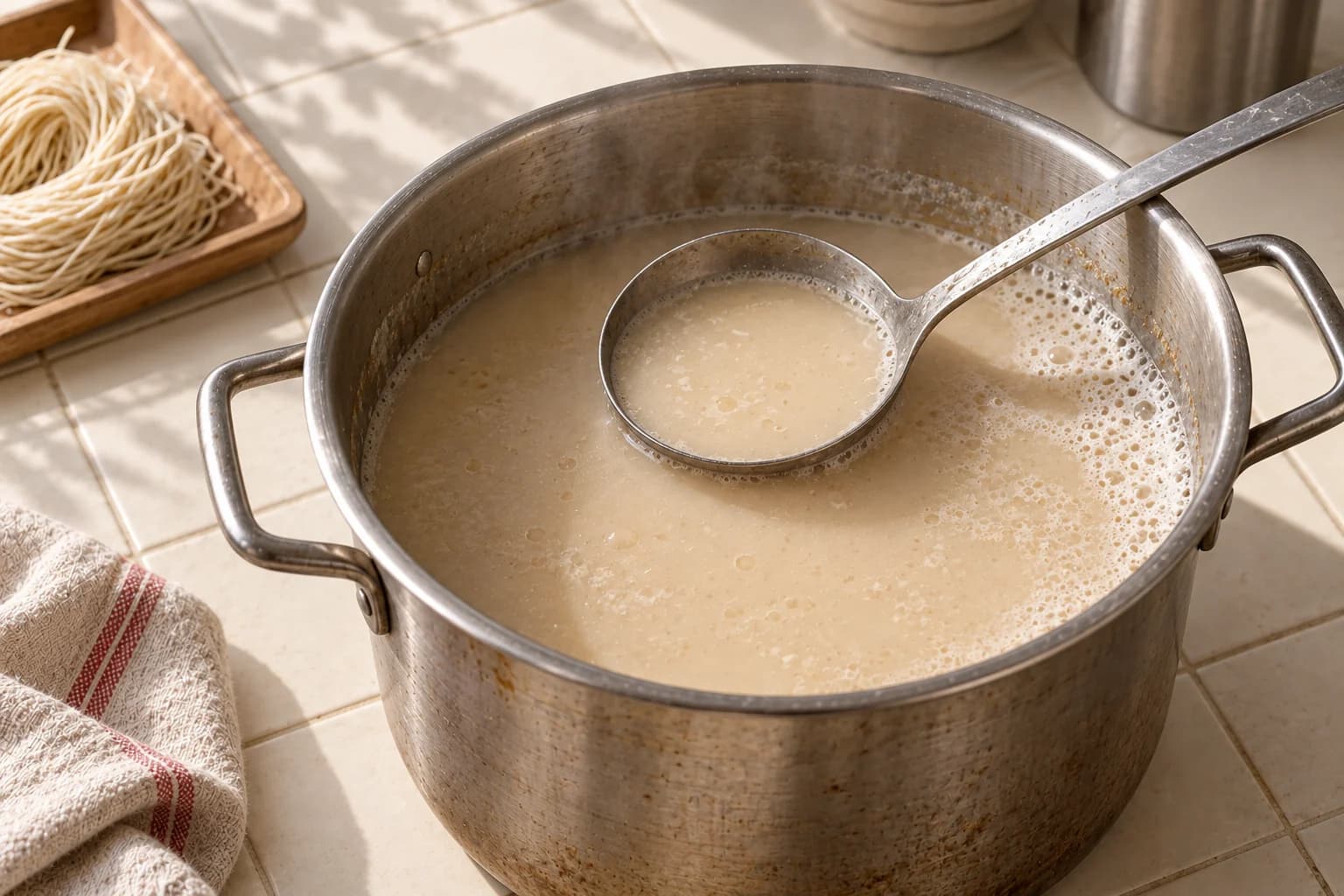
Tonkotsu ramen is not just another bowl of noodles. It is twelve hours of simmering pork bones until they surrender every last molecule of collagen, fat, and marrow. The result is a broth so thick and creamy it coats your lips after the first sip. Milky white, almost opaque, with an aroma that sits somewhere between roasted pork and something primal — the scent of slow extraction, of patience made edible. The first slurp is always a revelation: rich without being heavy, deeply savoury, with a viscosity that clings to the thin, straight noodles. This is not subtle food. This is food that announces itself.
Born in the street stalls of Fukuoka, tonkotsu ramen has become Japan's most recognisable ramen style worldwide. But between the Instagram bowls and the franchise hype, the craft behind a genuine tonkotsu gets lost. This guide covers the real thing — what makes it different, what goes into it, where to find excellent bowls in Paris, and how to attempt one at home.
What is tonkotsu ramen?
Tonkotsu (豚骨) literally translates to "pork bone." The style originated in Fukuoka, on the northern coast of Kyushu, Japan's southernmost main island. More specifically, it comes from the Hakata district — which is why you'll often see it called Hakata ramen. The legend dates to the late 1930s, though the style really crystallised in the post-war years when cheap pork bones were plentiful and protein was scarce.
What defines Hakata-style tonkotsu is the broth: white, opaque, collagen-dense, cooked at a rolling boil for hours. This aggressive boil is what separates tonkotsu from every other ramen style. Shoyu ramen has a clear, soy-seasoned broth. Shio ramen is delicate, salt-forward, often translucent. Miso ramen is thick but gains its body from fermented paste, not bone extraction. Tonkotsu gets its character entirely from the bones themselves — no shortcuts, no flavour boosters, just time and heat turning solid matter into liquid silk.
The key ingredients
The broth is everything. Pork leg bones, neck bones, sometimes femur bones — split or cracked to expose the marrow. They are blanched first for ten minutes in boiling water, then rinsed clean of scum and impurities. This step is non-negotiable: skip it and your broth will taste muddy instead of clean. Once blanched, the bones go into fresh water and cook at a vigorous, rolling boil for twelve to eighteen hours. The boiling action is what creates the emulsion — fat and collagen whipped into suspension by the turbulence, turning the liquid from clear to milky white. Some shops add trotters or skin for extra gelatin. The finished broth, when cooled, should set like jelly.
The noodles are thin, straight, and made from hard wheat flour with a low hydration rate. Hakata noodles are deliberately thin so they cook fast — thirty seconds to a minute — and are meant to be eaten quickly before they go soft. This is why Hakata ramen shops invented kaedama (替え玉): ordering a second portion of noodles to add to your remaining broth. You eat fast, order more, eat fast again. The noodles are a vehicle, not the star.
Chashu (チャーシュー) is braised pork belly, rolled and tied, then slow-cooked for two to three hours in a mix of soy sauce, mirin, sake, and sugar. The best chashu is soft enough to break apart with chopsticks but still holds its shape in the bowl. Some shops finish it with a blowtorch for caramelised edges. A good bowl gets two to three slices, laid across the surface like edible decoration.
Ajitsuke tamago (味付け卵) — the marinated soft-boiled egg. Cooked for exactly six to seven minutes so the yolk stays jammy and orange, then peeled and submerged in a soy-mirin marinade for twenty-four hours. When halved and placed in the bowl, the yolk should ooze slowly into the broth. It is the single most photographed element of any ramen bowl, and for good reason: the contrast of deep amber yolk against white broth is striking.
The supporting cast: nori (dried seaweed sheets, placed upright against the rim), menma (fermented bamboo shoots, adding crunch and a slightly sweet tang), thinly sliced green onions scattered across the surface, and beni shoga (pickled red ginger) served on the side for those who want a sharp, acidic counterpoint to the richness. Some shops also offer crushed garlic, sesame seeds, or spicy mustard greens (takana) as table condiments.
The best tonkotsu ramen in Paris
Ippudo Paris — The Hakata original, worldwide. Founded in 1985 by Shigemi Kawahara in Hakata, Ippudo is arguably the most famous ramen chain on earth. In Paris, they operate four locations: Saint-Germain, Louvre (74-76 rue Jean-Jacques Rousseau), République, and Bastille. The Shiromaru Classic is the benchmark — pure pork bone broth, thin noodles, chashu, spring onion, sesame. The Akamaru Modern adds red miso paste and garlic oil for a deeper, more complex profile. Around €14 per bowl. Expect queues at peak hours, but service is fast once seated. The broth is consistent across locations — rich, properly emulsified, not overly salty. For a first tonkotsu experience in Paris, Ippudo remains the safest recommendation.
Kodawari Ramen — The immersive experience. Two locations, two different worlds. Yokochō (rue Mazarine, 6th arrondissement) recreates a narrow Tokyo alleyway inside the restaurant — low ceilings, lanterns, fake facades. Selected in the Guide Michelin 2025. Tsukiji (rue Richelieu, 1st arrondissement) mimics the atmosphere of Tokyo's old fish market. The ramen itself is excellent — the tonkotsu broth is thick, the noodles are imported or made in-house, and the toppings are generous. Around €14-16 per bowl. The decor is what sets Kodawari apart: it is the most Instagrammable ramen experience in Paris, but the food backs up the aesthetic.
Worth mentioning: Isshin Paris, a newer address from the family behind Kodawari, with a matsuri (Japanese festival) ambiance that adds yet another layer of immersion.
An honest assessment: Paris's ramen scene is excellent and growing, but it remains concentrated within central Paris. If you live in western suburbs — Croissy, Chatou, Vésinet, Saint-Germain-en-Laye — your closest serious bowl requires a trip into the city. The gap is real, and it is one of the reasons specialised Japanese cuisine in the western suburbs deserves more attention.
How to make tonkotsu ramen at home
Making tonkotsu at home is not difficult. It is just long. The process breaks down into three key stages, each of which can be prepared independently.
Stage 1 — The broth. Buy two kilograms of pork leg bones or neck bones from your butcher (Asian supermarkets also stock them cheaply). Place them in a large pot, cover with cold water, bring to a boil and cook for ten minutes. This is the blanching step — it purges blood and impurities. Drain, rinse each bone under cold water, scrub off any dark residue. Return the clean bones to a fresh pot of water. Bring to a vigorous, rolling boil — not a gentle simmer, a full boil. This is critical: the turbulence is what creates the emulsion. Cook for a minimum of twelve hours, adding water as needed to keep the bones submerged. By the end, the liquid should be milky white and thick enough to coat a spoon. Season with salt and a splash of soy sauce. Shortcut: a pressure cooker can achieve a similar result in three to four hours at high pressure.
Stage 2 — The chashu. Take a piece of pork belly (about 500g), roll it tightly and tie with kitchen twine. Sear all sides in a hot pan. Then braise in a mixture of 100ml soy sauce, 100ml mirin, 50ml sake, 2 tablespoons sugar, and enough water to half-cover the meat. Simmer with a lid for two hours, turning occasionally. The meat should be fork-tender and deeply flavoured. Let it cool in the braising liquid, then slice into rounds before serving.
Stage 3 — The egg. Bring water to a boil. Gently lower refrigerated eggs into the water. Cook for exactly seven minutes for a jammy yolk. Transfer immediately to an ice bath. Peel when cool, then submerge in a mixture of equal parts soy sauce and mirin for twenty-four hours in the fridge. The result: deeply seasoned whites with a golden, flowing centre.
Assemble: hot broth in a bowl, cooked noodles (fresh ramen noodles, thirty seconds in boiling water), sliced chashu, halved egg, nori, sliced spring onions, and a few pieces of menma if you have them. Eat immediately. Slurp loudly — it is the correct way to eat ramen in Japan, and it aerates the broth across your palate.
Frequently asked questions
Why is tonkotsu broth cloudy?
The rolling boil emulsifies fats and collagen into the water, creating that opaque milky colour. It's intentional — a clear tonkotsu broth would mean insufficient cooking time or too gentle a simmer.
What is the difference between tonkotsu ramen and traditional ramen?
Tonkotsu is pork-bone-only broth. Other ramen styles use chicken broth (tori paitan), fish stock (niboshi), or vegetable bases. The cooking method also differs: tonkotsu requires a rolling boil, while most other broths are simmered gently.
Can you make vegetarian tonkotsu?
Not by definition — tonkotsu literally means 'pork bone.' But credible plant-based alternatives exist using soy milk or blended cashew-based broths that mimic the creamy, rich texture. They're good in their own right, just not tonkotsu.
Fancy trying authentic tonkotsu broth in West Paris?