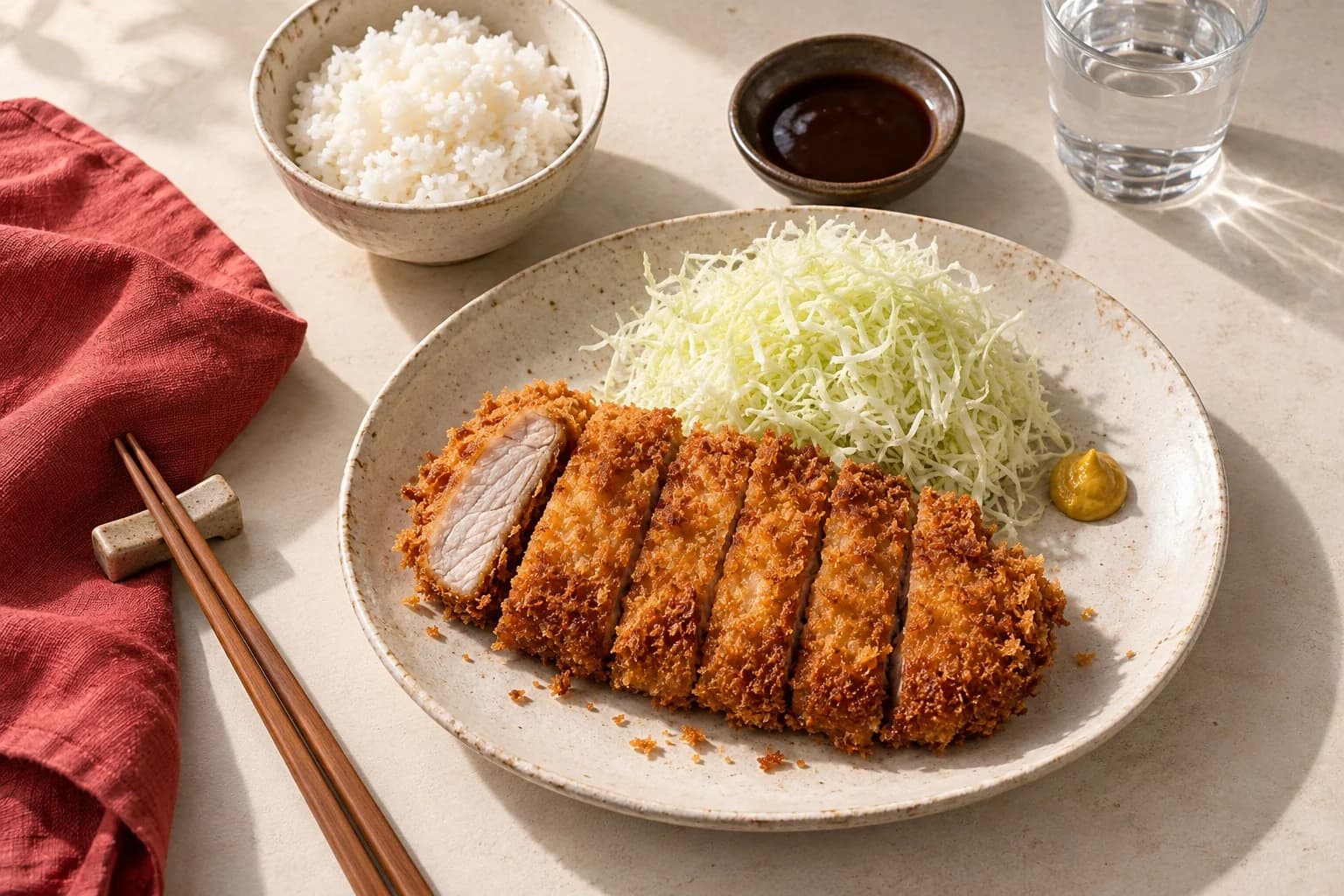
Tonkatsu is one of the most iconic dishes in Japanese cuisine. This pork cutlet coated in panko and deep-fried in clean oil has won over millions of food lovers around the world. But behind its apparent simplicity lies a demanding culinary art, a fascinating history, and a food culture deeply rooted in Japanese tradition. In this comprehensive guide, we explore everything you need to know about tonkatsu: its origins, technique, variations, and the best way to enjoy it.
The history of tonkatsu: from European origins to Japanese icon
Contrary to popular belief, tonkatsu is not a traditional Japanese dish in the strict sense. Its story begins in the late 19th century, during the Meiji era (1868-1912), when Japan opened up to the West and adopted many European influences, including culinary ones. The Meiji government encouraged meat consumption, which had been virtually absent from the Japanese diet for Buddhist reasons.
The concept of breaded and fried meat arrived in Japan via European cutlets — primarily the Austrian schnitzel and French côtelette. The first Western-style restaurants in Tokyo, called yōshoku-ya (洋食屋, Western cuisine restaurants), began serving breaded pork cutlets in the 1890s. At the time, the dish was simply called katsuretsu (カツレツ), a phonetic adaptation of the English word "cutlet".
The decisive transformation came in the 1920s-1930s. Japanese chefs progressively adapted the recipe: they replaced fine European breadcrumbs with panko (パン粉), a Japanese breadcrumb with large, airy flakes that produces an incomparably crispier, lighter crust. They switched from pan-frying to complete deep-frying, giving a more uniform, golden result. Finally, they paired the dish with quintessentially Japanese accompaniments: white rice, fresh shredded cabbage, miso soup, and house-made tonkatsu sauce.
This is when katsuretsu became tonkatsu (とんかつ or 豚カツ) — literally "pork" (ton, 豚) + "cutlet" (katsu, カツ). The dish left the yōshoku category to become a pillar of Japanese cuisine in its own right, alongside sushi and ramen. Restaurants entirely dedicated to tonkatsu opened across the country, some becoming legendary institutions like Tonki in Meguro (founded 1939) and Maisen in Omotesando.
Hire katsu vs rosu katsu: the two fundamental cuts
Every tonkatsu lover faces the same fundamental choice: hire katsu (ヒレカツ) or rosu katsu (ロースカツ)? This choice between the two main cuts lies at the heart of the tonkatsu experience, and the Japanese debate it passionately.
Hire Katsu (ヒレカツ)
Hire katsu uses the pork tenderloin. It is the most tender, leanest cut. The meat is remarkably delicate, almost melting beneath the panko crust. Hire katsu is often considered the "elegant" or "refined" choice. It is generally pricier because the tenderloin is a limited cut on each animal. Ideal for those seeking lightness and finesse, or trying tonkatsu for the first time.
Rosu Katsu (ロースカツ)
Rosu katsu uses the loin, a more marbled cut with a flavourful fat edge. It is the choice of purists and connoisseurs. The marbling melts during cooking, making the meat incredibly juicy and flavourful. The caramelised fat along the edge adds an extra dimension. Rosu katsu is generally thicker and more generous than hire, and is often the recommended cut at Japan's top tonkatsu houses.
Beyond these two classic cuts, there are other popular variations. Menchi katsu (メンチカツ) uses seasoned minced pork, shaped into a patty and breaded — more accessible, very flavourful. Cheese katsu (チーズカツ) features melting cheese inside the meat, a gourmet twist popular with younger diners. And ebi katsu (エビカツ) replaces pork with breaded shrimp, an alternative for those who don't eat pork.
The tonkatsu technique: why panko changes everything
The fundamental difference between tonkatsu and a simple breaded cutlet lies in the preparation technique, and at the heart of this technique is panko (パン粉). Panko is not simply breadcrumbs: it is an ingredient in its own right that defines the characteristic texture of tonkatsu.
Panko is made from crustless white bread, baked in a special oven that uses electrical current rather than conventional heat. This unique process produces bread with an extremely airy crumb and irregular air pockets. Once dried and crumbled, panko forms large, light, irregular flakes — radically different from the fine, compact European breadcrumbs.
When these panko flakes are fried, they create a crust of unparalleled lightness and crispness. The air trapped in the panko's pockets forms a barrier that prevents oil from penetrating the meat. The result: a golden, crispy exterior that crunches under the teeth, but meat that stays perfectly juicy and tender inside. It is this combination of textures — the airy crunch of the panko and the tenderness of the meat — that makes tonkatsu magical.
In the best tonkatsu houses in Japan, panko is prepared fresh every day. Some restaurants even bake their own bread specifically to achieve the ideal panko texture. This obsession with detail perfectly illustrates the Japanese philosophy of kodawari (こだわり) — the pursuit of perfection in the smallest details.
The teishoku: the art of the complete set
In Japan, tonkatsu is almost never served alone. It is part of a teishoku (定食), a "complete set" that constitutes a balanced, harmonious meal. The typical tonkatsu teishoku includes several elements that complement each other perfectly.
White rice (gohan, ご飯) is the foundation, always served plain in an individual bowl. Japanese rice, the koshihikari variety, is slightly sticky and perfect for absorbing tonkatsu sauce. Shredded cabbage (kyabetsu, キャベツ) is the inseparable accompaniment to tonkatsu: finely cut, it brings freshness and crunch that contrast with the rich crispness of the panko. At good restaurants, cabbage is served unlimited. Miso soup (miso shiru, 味噌汁) completes the teishoku with its comforting warmth and deep umami flavours.
And finally, tonkatsu sauce — that thick, sweet-savoury sauce based on worcestershire sauce enriched with fruits and spices. Each restaurant has its own secret recipe. Some also offer karashi mustard (からし), a sharp Japanese mustard that lifts the flavour of the meat. The art of dosing the sauce — not too much, so as not to mask the quality of the panko and pork — is the mark of a connoisseur.
Derived dishes: katsudon, katsu curry and katsu sando
Tonkatsu has given rise to several derived dishes that have become classics of Japanese gastronomy in their own right, each with its own identity and passionate fans.
Katsudon (カツ丼) is perhaps the most famous. It is a donburi (rice bowl) in which tonkatsu is simmered with onions and beaten eggs, then placed over steaming rice. The semi-liquid eggs envelop the tonkatsu in a silky texture, while the sweet-savoury dashi permeates the panko crust. In Japan, katsudon is considered a good-luck charm: the word "katsu" (カツ) is a homophone of "katsu" (勝つ) meaning "to win" or "to conquer". Students traditionally eat it before important exams to ensure victory.
Katsu curry (カツカレー) combines tonkatsu with Japanese curry — that mild, thick, comforting curry that bears no resemblance to Indian or Thai curries. The crispness of the tonkatsu contrasts wonderfully with the smoothness of the curry, all over a bed of rice. It is an immensely popular dish in Japan, served in both specialised restaurants and curry chains like CoCo Ichibanya.
Katsu sando (カツサンド), the tonkatsu sandwich, has become a global gastronomic phenomenon in recent years. A thick, still-crispy tonkatsu is inserted between two slices of ultra-soft Japanese sandwich bread (shokupan), with tonkatsu sauce and sometimes karashi mustard. The combination of soft bread, crispy panko, and juicy meat creates an extraordinary textural experience. The katsu sando from Maisen in Tokyo has become iconic.
Tonkatsu vs schnitzel: what are the differences?
The question comes up often: isn't tonkatsu simply a Japanese schnitzel? While the two dishes share a common ancestor — the European breaded cutlet — they have evolved in radically different ways and are today distinct dishes at every level.
The breadcrumbs are the first fundamental difference: schnitzel uses fine, compact breadcrumbs, while tonkatsu uses panko with large, airy flakes. The cooking method also differs: schnitzel is traditionally pan-fried in clarified butter, whereas tonkatsu is fully deep-fried in vegetable oil. The thickness of the meat is different too: schnitzel is pounded very thin, while tonkatsu maintains a generous 2-3 centimetre thickness. Finally, the accompaniments are radically different: schnitzel comes with potatoes and lemon, tonkatsu with rice, cabbage and tonkatsu sauce.
How to enjoy tonkatsu like a Japanese local
In Japan, the tonkatsu tasting follows an informal but well-established ritual. Here is how regulars at great tonkatsu houses enjoy their meal.
Start with the cabbage. Take a few bites of fresh shredded cabbage before even touching the tonkatsu. This prepares your palate and lets you appreciate the freshness that will contrast with the richness of the fried panko. Then taste a piece of tonkatsu plain, without sauce, to appreciate the quality of the meat and panko. Then try it with a touch of karashi mustard for a spicy kick, before moving to the tonkatsu sauce. Alternate between bites of tonkatsu, rice and cabbage to maintain a balance of flavours and textures throughout the meal. Finish with the miso soup to cleanse your palate.
A connoisseur's tip: in tonkatsu restaurants, freshness is paramount. Tonkatsu must be eaten immediately after being served, while the panko is at its crispiest. Waiting too long means the steam from the hot meat softens the panko crust. Regulars start eating as soon as the dish arrives — no endless photos!
Tonkatsu in West Paris: soon a reality
Today, Paris has a few excellent tonkatsu restaurants, mainly in the centre: Tonkatsu Tombo in the 15th (Montparnasse, 14 Rue de l'Arrivée), Katsu Katsu in the 2nd (Opéra district, 25 rue Saint-Augustin, opened January 2026). But West Paris — Croissy-sur-Seine, Chatou, Le Vésinet, Saint-Germain-en-Laye — has no specialised tonkatsu restaurant within a 12-kilometre radius.
This is exactly the gap that TontonKatsu aims to fill. Inspired by Tokyo's great houses — Tonki, Maisen, Butagumi — TontonKatsu will be the first restaurant in West Paris entirely dedicated to the art of tonkatsu. Fresh panko every day, premium pork, rigorous Japanese technique. The neighbourhood restaurant that West Paris never had.
Fancy trying real tonkatsu in West Paris?