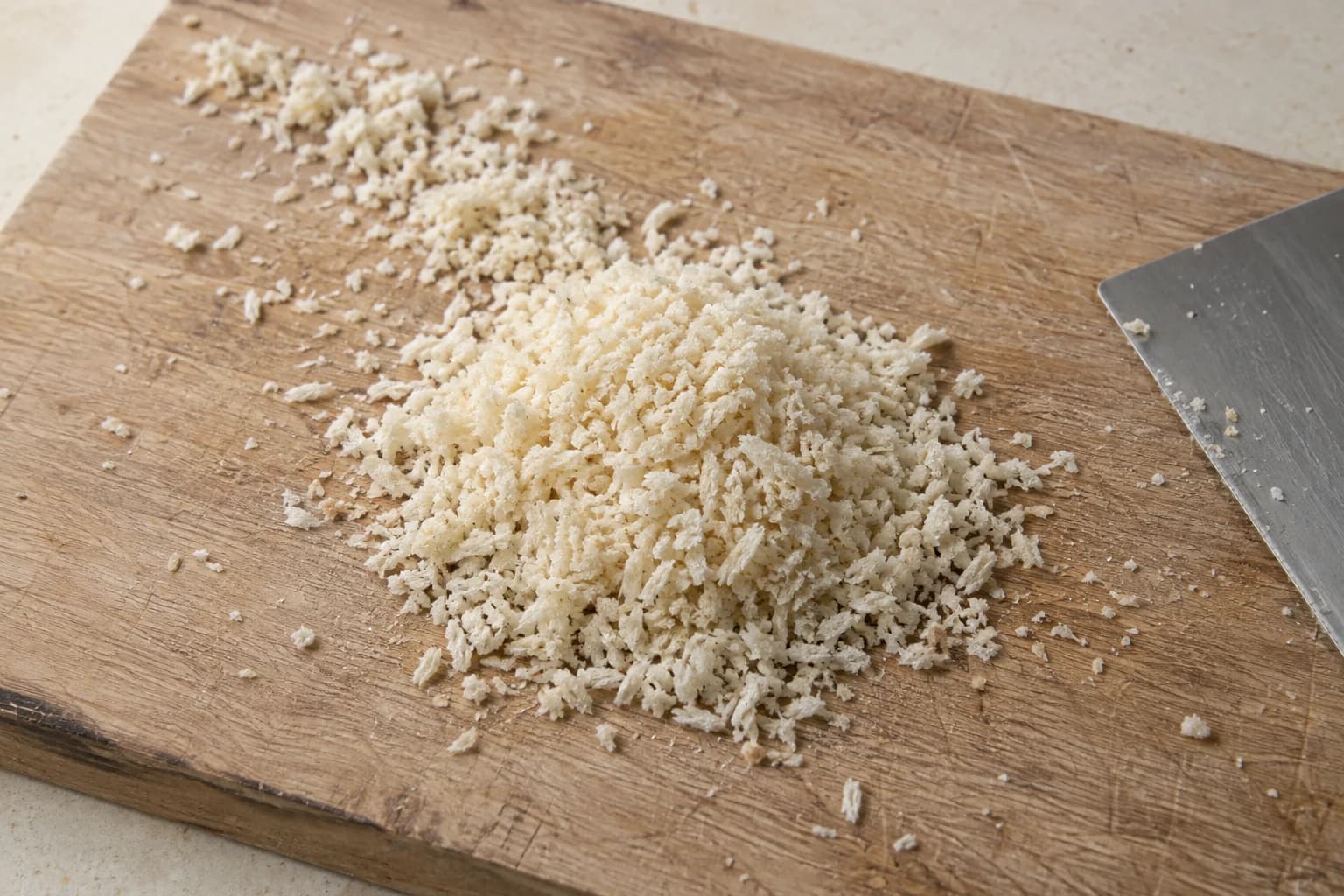
The texture you didn't know you were missing
Bite into a classic French escalope. Good, solid, reassuring. Now imagine the same piece of pork but wrapped in something that stays dry even after frying — a shell that shatters rather than chews, that lets the meat juice run freely without getting soaked into a greasy paste. That is what panko does. It does not just coat; it creates a separate layer, a second texture that plays against the meat rather than merging with it.
The difference is physical. Standard breadcrumbs are dense, compact, full of tiny air pockets that fill with oil the moment they hit a hot pan. Panko flakes are large — 2 to 4 mm — and hollow at the center. They sit against the surface of the food rather than bonding to it. When oil hits them, they brown from the outside in, leaving the interior crisp and almost dry. The result is a coating that weighs less, absorbs less fat, and holds its crunch for longer.
Panko vs regular breadcrumbs: what actually changes
| Criterion | Panko | Regular breadcrumbs |
|---|---|---|
| Flake size | 2–4 mm, coarse | 0.5–1 mm, fine |
| Structure | Open, hollow, airy | Dense, compact |
| Oil absorption | Low | High |
| Crunch | Dry, crystalline, long-lasting | Heavy, tends to go soft |
| Colour after frying | Pale gold to deep amber | Dark brown quickly |
| Texture on the palate | Light, shatters cleanly | Chewy, compact |
| Best use | Tonkatsu, fried fish, karaage | Gratin, stuffing, meatballs |
The electric shock story
Panko was not invented by a chef experimenting with texture. It emerged from the chaos of wartime Japan, and its origin is genuinely strange.
During the Second World War, Japanese military bakers needed to produce bread quickly without conventional ovens, which required fuel and infrastructure that was often scarce or destroyed. They discovered that running electric current through raw dough baked it from the inside out — no oven, no crust, just a dense, crustless white loaf cooked by resistance heating. The result was a bread with a completely different internal structure: large, open bubbles rather than the tight crumb you get from radiant oven heat.
When this crustless bread was ground and dried, the flakes were unlike anything produced by standard breadcrumb methods. Lighter. Larger. More irregular. Cooks quickly realized these flakes behaved differently in hot oil. They did not sink and soak — they floated against the surface, browned unevenly in the most appealing way, and left a coating that stayed crisp for minutes rather than seconds.
The electric baking method stuck. Today, industrial panko is still made this way: crustless bread, baked by electrical resistance, dried and milled into flakes. The wartime shortcut became the standard, because the standard could not match what the shortcut produced.
The 170–175°C window: why temperature matters more than you think
Panko is forgiving in some ways and brutally unforgiving in others. The temperature of the oil is not adjustable within a wide range — it is a precise window, and missing it changes the result completely.
Below 165°C, something bad happens. The oil is not hot enough to flash-seal the surface of the panko flakes before they begin to absorb. Instead of crisping, they saturate. The coating turns heavy, greasy, pale — the exact opposite of what you want. The pork inside may cook through, but the crust is already lost.
Above 180°C, the panko browns faster than the meat cooks. You pull out a piece that looks perfect — deep gold on the outside — and cut it open to find pink in the center. Or you leave it in long enough for the meat to cook, and the coating has gone past golden into bitter brown.
The sweet spot is 170–175°C. At this temperature, the flakes seal almost instantly, the coating builds colour at the same rate the meat cooks through, and the fat content of the pork — especially rosu katsu with its fat cap — has time to render properly without the outside burning. A 2 cm thick cut needs roughly 4 to 5 minutes per side at this temperature. Use a thermometer. Trust it more than the colour.
How to make panko at home
You cannot replicate electric-baked bread in a domestic kitchen, but you can get close enough to matter. The key is starting with crustless white bread — supermarket sandwich bread works, as long as it is white and soft.
- Remove all the crust. Any crust in the mix will create hard dense particles that behave like regular breadcrumbs.
- Tear the crumb into rough pieces, then grate on the large holes of a box grater. Do not pulse in a food processor — it over-processes and destroys the flake structure.
- Spread on a baking tray in a thin, even layer.
- Dry in an oven at 100°C for 20 to 25 minutes. You want dry and pale, not toasted. Pull them before they take on any colour.
- Cool completely before using. Warm panko softens and clumps.
The result will be less uniform than commercial panko — your flakes will vary in size and shape — but they will behave in oil almost identically. For tonkatsu made at home, the difference from store-bought is minor. For a restaurant kitchen producing fifty covers, you need the consistency of industrial panko.
Where to buy panko in France
Good panko is more widely available in France than it used to be. Here is where to look, in order of reliability:
- Asian grocery stores — Paris Store, Tang Frères, K-Mart, Thanh Long and their regional equivalents all carry panko, usually in the Japanese or Korean baking aisle. Look for bags between 200 g and 1 kg. Prices are reasonable and the stock turns over fast, so freshness is rarely an issue.
- Supermarkets — Carrefour and Monoprix in larger cities now stock panko in the world foods section, usually under the Blue Dragon or Kikkoman brand. Selection is limited but reliable.
- Picard — Sells a frozen panko-coated product (not raw panko), which is useful for reference but not for coating your own meat.
- Online — Amazon France and Japan Centre ship Japanese brands (Nisshin, Kikkoman) with delivery in 2 to 3 days. Useful if you need a specific grade (fine vs coarse) or a large quantity.
Brands worth knowing: Kikkoman panko is widely available and consistent. Blue Dragon is the most common supermarket option. For the most authentic result, Japanese import brands like Nisshin or Yamazaki — available online — produce a lighter, more open flake.
Panko and the logic of tonkatsu
Tonkatsu is not a dish that hides behind its coating. The pork is the point — its quality, its thickness, the fat rendered just enough, the juices still running. The panko is there to protect all of that, to create a barrier between the meat and the oil while adding a textural counterpoint that makes every bite more interesting.
Standard breadcrumbs work against this. They absorb, they merge, they dominate. The coating becomes the loudest thing on the plate. Panko steps back. It does its job quietly, and then it gets out of the way.
That is not a small detail. In a dish as deliberate as tonkatsu, it is everything.
FAQ — Panko
What is the difference between panko and regular breadcrumbs?
Panko is made from crustless bread baked using electric current, producing large airy flakes (2–4 mm) rather than fine crumbs. It absorbs less oil, stays crisp longer, and delivers a lighter crunch where regular breadcrumbs give a dense, greasy result.
What temperature should you fry panko at?
For a perfect panko tonkatsu, the ideal temperature is 170–175°C. Below that, panko absorbs too much oil. Above it, the crumbs burn before the meat is cooked through.
Where can you buy panko in France?
Asian grocery stores (Thanh Long, K-Mart, Paris Store), supermarkets with a world foods aisle (Carrefour, Monoprix), and online via Amazon France or Japan Centre. Reliable brands: Kikkoman, Blue Dragon, Nisshin.
Can you make panko at home?
Yes. Remove the crusts from white sandwich bread, grate the crumb on a box grater, spread on a tray and dry in the oven at 100°C for 20–25 minutes. The result is less uniform than commercial panko but behaves similarly in oil.
Read next
Hire katsu vs rosu katsu: which cut should you choose?Tonkatsu sauce: history, homemade recipe and best brandsWhat is tonkatsu? The complete guide to Japan's iconic dish