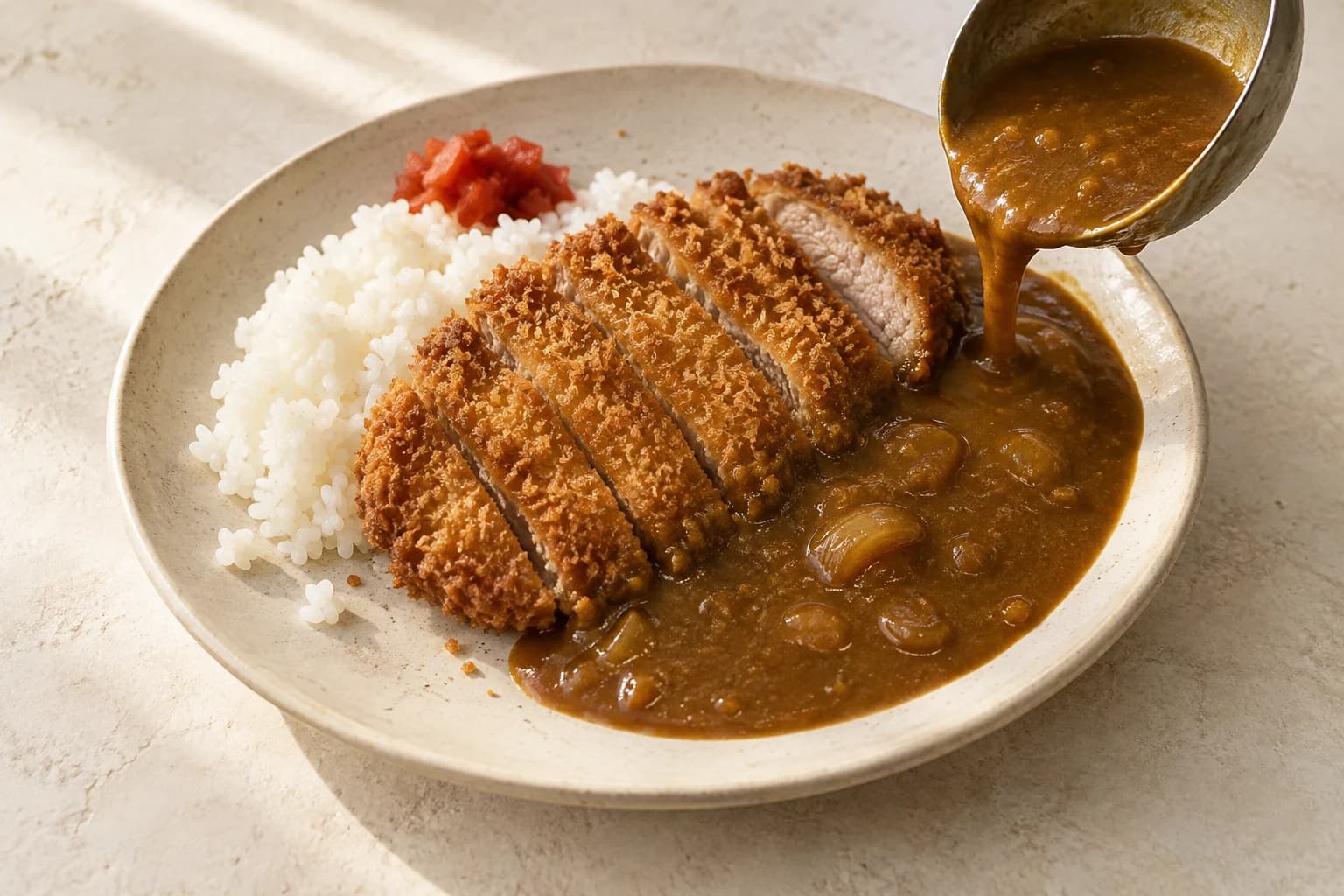
Take a perfectly fried tonkatsu, place it on a bed of steaming rice, and pour a thick, glossy Japanese curry sauce over half of it. That is katsu curry: a dish that combines two of Japan's most beloved comfort foods into something greater than the sum of its parts. It is one of the most searched Japanese dishes worldwide, and for good reason.
What is katsu curry, exactly?
Katsu curry (カツカレー) is the marriage of two pillars of Japanese cuisine: tonkatsu (breaded, deep-fried pork cutlet) and Japanese curry (karē raisu, カレーライス). The dish is served on a single plate or tray: rice on one side, the sliced tonkatsu on top or beside it, and curry sauce ladled generously over the cutlet so that the panko crust partially soaks it up while the top stays crisp.
The result is a textural conversation: crunchy panko, tender pork, smooth velvety curry, and fluffy rice. Each bite can combine all four, or you can alternate between the crispy uncovered part and the sauce-soaked side for contrast.
Origins: a very Japanese invention
Japanese curry itself arrived in Japan via the British Navy in the late 19th century during the Meiji era. The Japanese adapted it dramatically: they thickened it into a smooth roux, sweetened it with grated apple and honey, and tamed the spice level. By the early 20th century, curry rice was a staple of Japanese home cooking and military mess halls alike.
The exact moment someone placed a tonkatsu on top of curry rice is debated, but it is widely attributed to a customer at a Tokyo yoshoku restaurant in the 1940s or 1950s who simply asked for both on the same plate. The combination was so natural and satisfying that it spread rapidly. Today, katsu curry is served everywhere in Japan, from chain restaurants like CoCo Ichibanya (which sells over 100 million servings a year) to high-end tonkatsu houses.
Japanese curry vs Indian and Thai curry
Japanese curry is fundamentally different from its Indian and Thai cousins. Where Indian curry builds on fresh spice pastes and Thai curry on coconut milk and chilli heat, Japanese curry relies on a cooked roux (flour and fat browned with curry powder) that produces a thick, glossy sauce with gentle warmth rather than aggressive heat.
The standard Japanese curry base includes onions (cooked down until deeply caramelised), carrots, potatoes, and a commercial or homemade roux block. Many recipes add grated apple for sweetness, soy sauce for umami depth, and a touch of honey. The result is mild, aromatic, slightly sweet, and deeply comforting. Japanese children grow up eating it weekly. It is to Japan what mac and cheese is to America.
The anatomy of a great katsu curry
The tonkatsu
A great katsu curry starts with a great tonkatsu. The cutlet should be fried to order, with a crisp golden panko crust and juicy interior. Both hire katsu and rosu katsu work beautifully. Rosu is more traditional for katsu curry, as its fat marbling holds up well against the rich sauce.
The curry sauce
The sauce should be thick enough to coat the back of a spoon but fluid enough to pool around the rice. Flavour should be layered: gentle spice, fruit sweetness, umami depth. A great curry roux takes hours of slow cooking to develop, just like a great tonkatsu sauce.
The rice matters too. Japanese short-grain rice, steamed and slightly sticky, is the only appropriate choice. It absorbs the curry without dissolving, and provides a neutral base that lets the curry and tonkatsu flavours shine. Common garnishes include fukujinzuke (pickled red vegetables) or rakkyo (pickled shallots), which cut through the richness with acidity and crunch.
How to spot a good katsu curry
The tonkatsu should be sliced and visibly fresh, not pre-fried and reheated. Look for a clear colour contrast: golden panko on top, glossy dark curry on the side. The curry should look smooth and homogeneous, not grainy or broken. If the restaurant makes its own curry roux rather than using commercial blocks, that is a strong signal of quality.
A warning sign: if the entire tonkatsu is drowned in curry with no crispy surface visible, the kitchen likely fried the cutlet in advance and is using the sauce to hide soggy panko. A good katsu curry always shows you both textures.
Katsu curry vs katsudon: two ways to build on tonkatsu
Both katsudon and katsu curry take the same base (tonkatsu + rice) in completely different directions. Katsudon simmers the cutlet in dashi broth with egg and onion, turning it into something soft, savoury, and almost soupy. Katsu curry keeps the cutlet crispy and pairs it with a thick, spiced sauce. Katsudon is subtle and delicate; katsu curry is bold and enveloping. Both are essential to the tonkatsu repertoire.
Katsu curry at TontonKatsu
When TontonKatsu opens, katsu curry will be on the menu. Our approach: a house curry roux, slow-cooked with onions, apple, and a spice blend developed for balance rather than heat. Poured over a freshly-fried cutlet with our daily panko, served with properly steamed rice and house-pickled fukujinzuke. The kind of katsu curry you crave on a rainy day, or any day.
Follow TontonKatsu to be the first to try our katsu curry in West Paris.