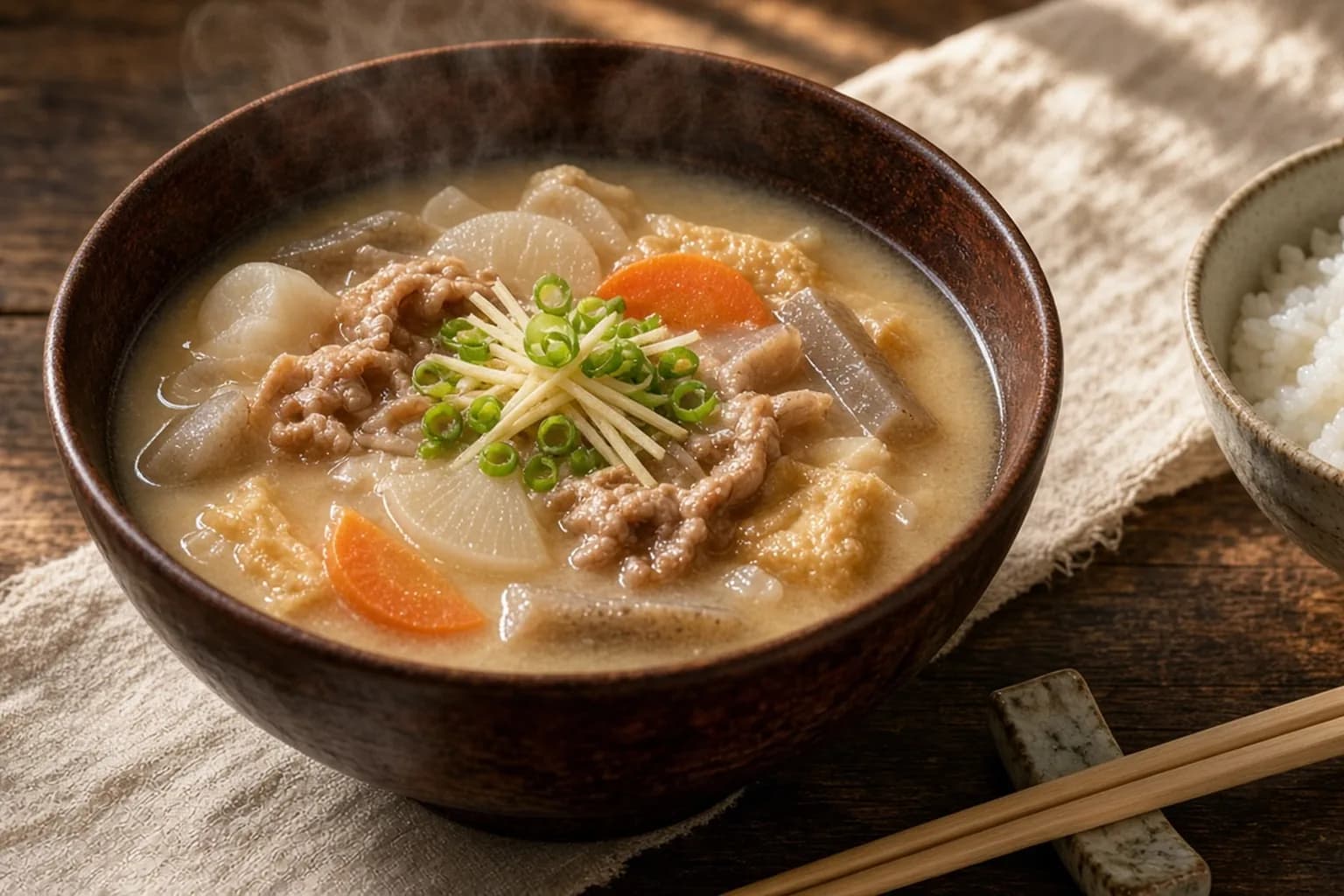
Tonjiru is a miso soup loaded with pork and vegetables, hearty enough to make a meal with nothing more than a bowl of rice. It is written 豚汁 and also read "butajiru": two readings of the same name, which means "pork soup". In Kagoshima, according to a page from Japan's Ministry of Agriculture, Forestry and Fisheries, people eat it all year round but make it more often in winter to warm up, and the same page describes it as popular across Japan. A good reason to bring it out as the evenings draw in.
Tonjiru versus tray miso soup: two different jobs
In our teishoku article, miso soup is one element of the tray among others, next to the rice, pickles and main dish. Tonjiru changes the job description: the filled soup becomes the centre of the meal.
| Miso soup in our teishoku article | Tonjiru | |
|---|---|---|
| Role | Accompanies a main dish | Can be the meal, with rice |
| Fillings | Light: tofu, wakame, green onion | Generous: pork, root vegetables, konnyaku, fried tofu |
The pork and vegetables are first stir-fried in a little oil, then simmered in the broth until tender; the miso goes in at the end.
What goes in it
The official page on Kagoshima tonjiru lists its main ingredients as pork, daikon (white radish), carrot, satoimo (taro), konnyaku, atsuage (thick fried tofu) and miso, with green onion and ginger added at serving time. Above all, it notes that apart from the pork, the vegetables can be whatever you have left, and that the recipe varies from one household to another.
Namiko Hirasawa Chen, author of Just One Cookbook, adds burdock root (gobo) and also suggests kabocha squash, sweet potato, mushrooms or napa cabbage. She uses thinly sliced pork belly, or pork loin, the cut used for rosu katsu, for a leaner version. According to Japan's Ministry of Agriculture, Ishikawa's metta-jiru, a tonjiru "generously filled" with root vegetables, uses sweet potato instead of potato.
Miso changes from region to region too. In Kagoshima, the mild climate favours barley miso (mugi miso), rich in koji, relatively low in salt and sweet; tonjiru is one of the region's signature dishes combining pork and miso.
A published recipe: the Kagoshima page
This recipe is published by Japan's Ministry of Agriculture in its "うちの郷土料理" (our regional home cooking) database and was provided by the non-profit Kirishima Shokuiku Kenkyūkai. We translate it without adapting it. It is not a recipe developed or tested by TontonKatsu.
Serves 4:
- 80 g thinly sliced pork;
- 100 g daikon, 50 g carrot, 100 g satoimo;
- 50 g konnyaku, 50 g atsuage;
- green onion and ginger, to taste;
- for the broth: 20 g iriko, 3 cups ("3 カップ") water and 50 g barley miso;
- a little oil.
- Put the iriko in the water. After 30 minutes, heat it; remove the fish 3 minutes after it comes to the boil.
- Cut the ingredients into bite-sized pieces. Stir-fry the pork in the oil, then add everything else except the green onion and ginger. Once everything is coated in oil, pour in the broth and cook, skimming as you go. When the vegetables are tender, dissolve the miso.
- Serve topped with sliced green onion and finely julienned ginger.
The page does not state the size of its "cup". Kikkoman, for example, uses 200 ml per cup in its recipes: on that convention, allow about 600 ml. Iriko are dried baby sardines or anchovies used for stock.
With a more familiar dashi, the Just One Cookbook version stir-fries the pork and vegetables in toasted sesame oil, covers them with dashi and simmers. She recommends white, red or blended (awase) miso, adjusted to its saltiness, and advises against very sweet saikyō and intensely flavoured hatchō. She dissolves the miso off the heat, reheats without boiling to keep its aroma, and finishes with grated ginger.
Allergens: what to check
Several tonjiru ingredients are among the allergens that must be declared in France:
- soy: miso, tofu, atsuage and aburaage;
- fish: iriko, the bonito in classic dashi, and some misos with added fish ingredients;
- cereals containing gluten: the barley in barley miso;
- sesame: the sesame oil in the Just One Cookbook version.
This list is not exhaustive: read every label, including instant dashi and spice blends. For a plant-based version, Just One Cookbook replaces the pork with tofu, mushrooms or more vegetables, using kombu or shiitake dashi and a miso without added fish. At that point it is no longer strictly a "pork soup".
Making it ahead and storing it
According to Just One Cookbook, tonjiru tastes even better the next day; the author suggests stopping the recipe before the miso and adding it only when reheating.
On food safety, the US Department of Agriculture's Food Safety and Inspection Service (USDA FSIS) recommends that you:
- refrigerate within 2 hours of cooking;
- divide a large pot into shallow containers, because it cools slowly;
- eat leftovers within 3 to 4 days from the refrigerator;
- bring soups to a rolling boil when reheating.
Our way of reconciling the two: bring the miso-free base to a boil, turn off the heat, then dissolve the miso. If the miso is already in, the USDA's boil still applies, at some cost to aroma. To freeze, Just One Cookbook first removes any potato and the konnyaku, whose texture changes, and recommends eating it within a month for best flavour.
And alongside tonkatsu?
Swapping the miso soup in a tonkatsu teishoku for tonjiru is tempting. That is our opinion, not a rule from our sources: the pork appears twice and the tray becomes much heavier. On an autumn evening, tonjiru with rice is enough on its own; keep tonkatsu and its panko crust for another day.
TontonKatsu is still a restaurant project in preparation: this tonjiru is not served anywhere under our name.
One practical question
Do you need dashi?
No. Just One Cookbook notes that the pork and vegetables already give plenty of flavour, but prefers to add dashi for extra umami. The Kagoshima page uses an iriko stock.
Sources consulted on 29 October 2026
- Japan's Ministry of Agriculture (MAFF): Tonjiru, Kagoshima: ingredients, season, regional context and recipe provided by the Kirishima Shokuiku Kenkyūkai non-profit; undated page.
- MAFF: aff magazine, June 2023, regional miso soups: Ishikawa's metta-jiru.
- MAFF: aff magazine, February 2021, miso basics: rice, barley and soybean miso.
- Just One Cookbook: Tonjiru, Namiko Hirasawa Chen: two readings of the name, ingredients, variations, making ahead and storage; page updated 11 February 2025.
- Just One Cookbook: Iriko Dashi: definition of iriko.
- Kikkoman: measurement conventions: 1 cup = 200 ml in its recipes.
- USDA FSIS: Leftovers and Food Safety: cooling, storage time and reheating; updated 31 July 2020.
- Service-public.fr (Entreprendre): allergens to declare: regulatory list of allergens.