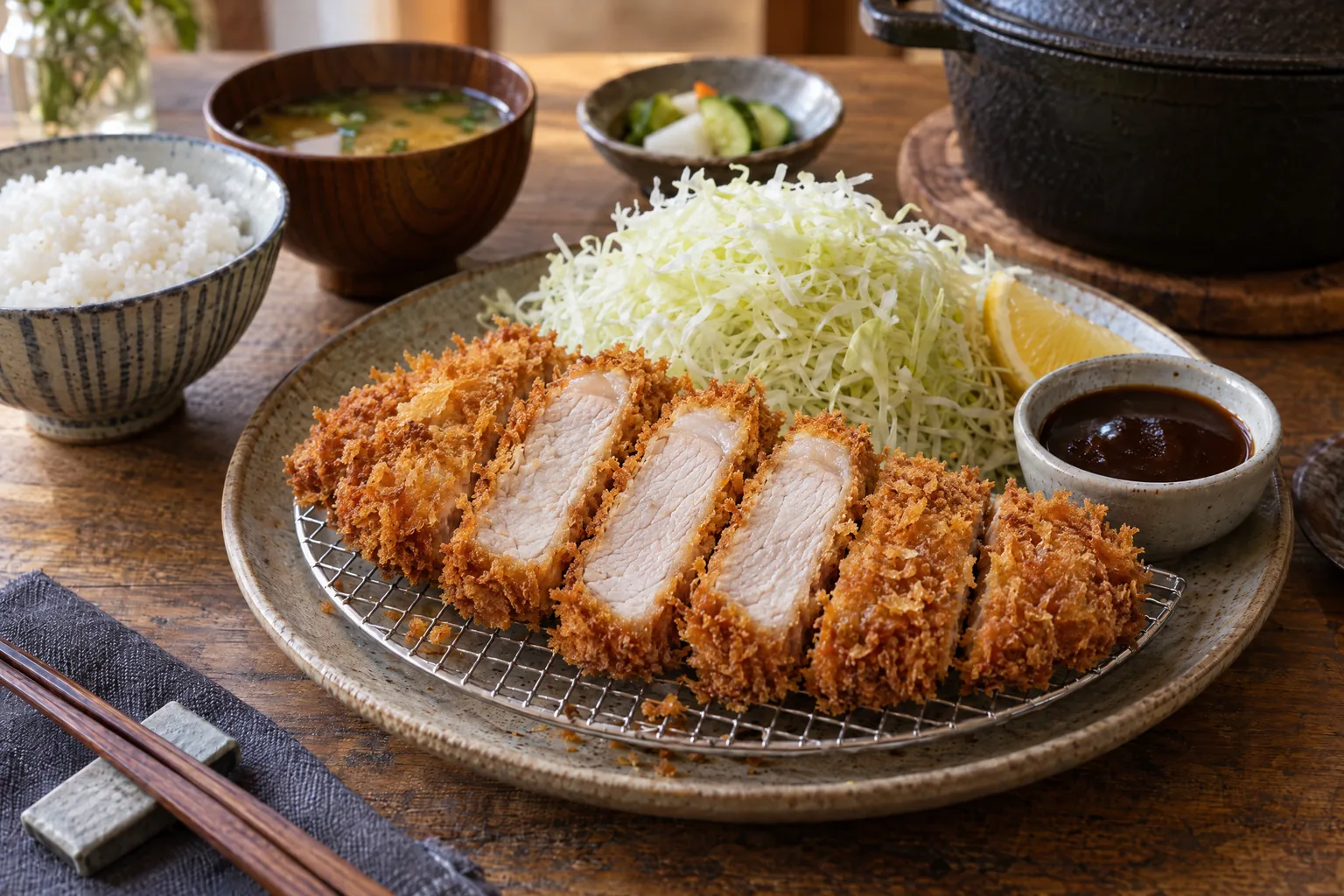
Good homemade tonkatsu comes down to three moves: cut through the sinew along the fat so the slice stays flat, bread it with no gaps, then fry at a moderate temperature first and finish hotter. That is the logic set out by the Japan Meat Information Service Center (JMI), a public-interest foundation: put the meat into oil at the right temperature, lower the heat to cook the inside, then raise it at the end to crisp the crust. Below is a published Japanese recipe, translated with its quantities, followed by what changes from one source to another.
For the dish's history and variations, start with what is tonkatsu.
The cut: loin or tenderloin
The Kikkoman and Just One Cookbook recipes both use pork loin, the cut behind rosu katsu. Tenderloin gives hire katsu, which is leaner; the difference is explained in our hire katsu vs rosu katsu article. Just One Cookbook uses slices 1 to 1.3 cm thick, about 100 g each.
Kikkoman's recipe, for 2
This recipe is by the cook Makiko Oda and published on Kikkoman's recipe site, "Home Cooking". We translate it without adapting it. It is not a recipe developed or tested by TontonKatsu. Its framing sums up the idea: think of it as "sealing the meat inside the coating and steaming it".
- 2 slices of pork loin cut for tonkatsu (250 g in total);
- ¼ teaspoon salt, a little pepper;
- 1 tablespoon flour;
- 60 g panko ("1½ cups");
- for the batter: 1 egg and 4 tablespoons flour;
- 2 cabbage leaves;
- oil for deep-frying;
- chūnō sauce, medium-thick (the recipe names the brand's own).
- Cut through the sinew between the meat and the fat. Cover the meat with cling film and pound it 30 to 40 times, then season with salt and pepper.
- Beat the egg in a bowl and mix in the 4 tablespoons of flour.
- Dust the meat with the tablespoon of flour. Spread the panko in a large tray. Holding the meat with a bamboo skewer, dip it in the batter, then coat it in panko.
- Heat the oil to 160 °C. Add the meat and fry for 5 to 6 minutes over medium heat. Turn it over, raise the temperature and fry for another 1 to 2 minutes. Drain.
- Cut into slices about 1.5 cm wide, pressing the knife down in one go. Soak the cabbage in water, remove the core, roll the leaves and shred them finely. Serve with the sauce poured over and the cabbage alongside.
In its recipes, Kikkoman counts 15 ml per tablespoon, 5 ml per teaspoon and 200 ml per cup.
Three sources, three ways to fry
Timings vary between sources, but the principle holds: all of them start between 160 and 175 °C, and all of them finish hotter.
| Source | Starting oil | First stage | Finish |
|---|---|---|---|
| Kikkoman | 160 °C | 5 to 6 min over medium heat | turn, raise the heat, 1 to 2 min |
| JMI | 170 °C (recommended range: 170 to 175 °C) | 20 s untouched, then lower heat, 2 to 3 min per side | high heat, 20 to 30 s |
| Just One Cookbook | 170 °C | 1 min per side, then 4 min resting on a rack | 180 °C, 30 s per side |
The JMI explains why: if the oil stays too hot, the coating burns while the inside is still raw. It recommends at least 7 to 8 cm of oil and keeping half of the surface free; too much meat at once makes the temperature drop. Just One Cookbook fries one piece at a time and skims off the crumbs between batches.
Without a frying thermometer, the JMI suggests a test: a pinch of panko that sinks about 1 cm, rises straight back up and scatters means roughly 170 °C. If it stays at the bottom, the oil is too cold; if it sizzles and browns at once, it is too hot.
For doneness, the JMI notes that the large bubbles at the start get smaller and the sound fades as the meat cooks. That is a cue, not a guarantee: France's food safety agency, Anses, recommends cooking foods of animal origin, pork and poultry in particular, to a core temperature of 70 °C. A thermometer in the centre of the slice remains the safest check.
The moves that prevent failures
- Cut deep enough. According to the JMI, a slice that curls up comes from cuts that were skipped or too shallow. Just One Cookbook slits the band between the lean meat and the fat on both sides.
- Tenderise. Pounding the meat makes it more tender and speeds up cooking, the JMI notes.
- Salt shortly before breading. The JMI seasons 5 to 6 minutes beforehand, then pats the juices dry with kitchen paper.
- Flour lightly. Uneven flour stops the egg and panko from sticking, so the coating comes away in the oil (JMI).
- Choose your panko. According to the JMI, fresh panko (nama panko) seems to be preferred for tonkatsu because it fries up lighter. With dry panko, Just One Cookbook mists it with water and waits 15 minutes for it to soften. More in our panko guide.
- Don't touch it too soon. Let the coating set before turning: 20 seconds for the JMI, 30 seconds for Just One Cookbook.
No deep-frying: the oven, and the air fryer
Just One Cookbook publishes an oven version. Toast ¾ cup of panko with 1 tablespoon of oil in a frying pan, let it cool, then bread as usual. Bake on a rack at 200 °C (15 °C lower in a fan oven) for about 20 minutes, until the meat is no longer pink inside. Rest for 3 minutes before slicing.
For the air fryer, the site has no dedicated recipe. Under its chicken katsu recipe, the team tells readers to adapt the oven version: panko toasted in a pan, then, for chicken, 190 °C for 12 to 15 minutes, turning halfway (reply dated 1 July 2026). For pork, no time is given: check for 70 °C at the core.
And with chicken?
For chicken katsu, Just One Cookbook butterflies the breast, pounds it to 6 mm–1.3 cm, then fries it at 170 °C for 3 minutes, turning it halfway. The Anses advice applies to poultry too.
Serving, storing, using leftovers
Very finely shredded cabbage goes with tonkatsu in Japan, Just One Cookbook points out; it also serves a sesame sauce made from toasted seeds, ground and mixed into the sauce. To choose or replace the sauce, see our tonkatsu sauce article. Add rice and soup and you have the teishoku tray.
Just One Cookbook freezes leftovers for up to a month and reheats them in a 180 °C oven: 15 to 20 minutes if thawed, 30 to 40 minutes from frozen, checking that the inside is hot. Leftovers can also become katsudon or a katsu sando: that is our suggestion, not an instruction from the sources.
Allergens and safety
Among the allergens that must be declared in France, tonkatsu contains at least cereals containing gluten (flour, panko) and eggs. Add sesame if you serve the sesame sauce, and mustard if you offer mustard. Read the labels on the sauce and the panko.
If the oil catches fire, the City of Paris is clear: never throw water on it, as the oil would overflow and flare up instantly. Turn off the heat and cover the pan with a lid or a damp towel. For used oil, Just One Cookbook refers to local collection rules: check with your local authority.
Want to taste it first?
Our tonkatsu in Paris article gives one verified address and the words to look for on a menu. TontonKatsu is still a restaurant project in preparation: this tonkatsu is not served anywhere under our name.
Sources consulted on 3 November 2026
- Japan Meat Information Service Center (JMI) — Frying meat: cuts, seasoning, breading, oil depth and temperature, panko test, two-stage frying; undated page.
- Kikkoman Home Cooking — Tonkatsu, recipe by Makiko Oda: translated quantities and steps; undated page.
- Kikkoman — measuring conventions: 200 ml cup, 15 ml and 5 ml spoons.
- Just One Cookbook — Tonkatsu: cut, panko, double frying, storage; recipe published 21 February 2025.
- Just One Cookbook — Baked Tonkatsu: oven version; updated 9 February 2025.
- Just One Cookbook — Chicken Katsu: chicken version and air-fryer reply; published 4 July 2025.
- Anses — Salmonellosis: 70 °C core cooking temperature.
- Service-public.fr (Entreprendre) — allergens to declare: regulatory list; checked 23 October 2025.
- City of Paris — Fire prevention: cooking-oil fires.